Loading...
Searching...
No Matches
fiber::FormatHex< UInt > Struct Template Reference
#include <OStream.hpp>
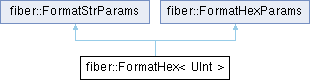
Inheritance diagram for fiber::FormatHex< UInt >:
Public Member Functions | |
| FormatHex (const UInt &v) | |
| constexpr FormatHex & | head () |
| enable the hex header '0x' in the beginning. | |
| constexpr FormatHex & | nohead () |
| disable the hex header '0x' in the beginning. | |
| constexpr FormatHex & | lead () |
| enable leading zeros of the hex number | |
| constexpr FormatHex & | nolead () |
| disables leading zeros of the hex number | |
| constexpr FormatHex & | lower () |
| use lower case letters for the hex number | |
| constexpr FormatHex & | upper () |
| use uppercase letters for hex numbers | |
| constexpr FormatHex & | mwidth (int mw) |
| Sets the minimum number of character that will be put into the stream. | |
| constexpr FormatHex & | left () |
| Formats the string to the left area set by mwidth(). | |
| constexpr FormatHex & | right () |
| Formats the string to the left area set by mwidth(). | |
| constexpr FormatHex & | center () |
| Formats the string to the left area set by mwidth(). | |
| constexpr FormatHex & | fill (char c) |
| Sets the fill characters used by padding that is applied when mwidth() is used. | |
Public Attributes | |
| UInt | _value |
 Public Attributes inherited from fiber::FormatStrParams Public Attributes inherited from fiber::FormatStrParams | |
| AlignmentLRC | _alignment = AlignmentLRC::Right |
| int | _mwidth = 0 |
| char | _fill = ' ' |
| Public Attributes inherited from fiber::FormatHexParams | |
| bool | include_header = true |
| bool | force_digits = true |
| bool | lowercase = true |
Constructor & Destructor Documentation
◆ FormatHex()
template<std::unsigned_integral UInt>
|
inline |
Member Function Documentation
◆ center()
template<std::unsigned_integral UInt>
|
inlineconstexpr |
Formats the string to the left area set by mwidth().
Example:
void endl(OStream &stream)
Writes a new line character to the stream followed by a call to OStream::flush()
Definition OStream.hpp:198
Formats a string and allows to pass an additional size parameter.
Definition OStream.hpp:261
constexpr FormatStr & mwidth(int mw)
Sets the minimum number of character that will be put into the stream.
Definition OStream.hpp:387
constexpr FormatStr & center()
Formats the string to the left area set by mwidth().
Definition OStream.hpp:423
- Returns
- self
◆ fill()
template<std::unsigned_integral UInt>
|
inlineconstexpr |
Sets the fill characters used by padding that is applied when mwidth() is used.
- Parameters
-
c The new fill character
- Returns
- self
◆ head()
template<std::unsigned_integral UInt>
|
inlineconstexpr |
enable the hex header '0x' in the beginning.
◆ lead()
template<std::unsigned_integral UInt>
|
inlineconstexpr |
enable leading zeros of the hex number
◆ left()
template<std::unsigned_integral UInt>
|
inlineconstexpr |
◆ lower()
template<std::unsigned_integral UInt>
|
inlineconstexpr |
use lower case letters for the hex number
◆ mwidth()
template<std::unsigned_integral UInt>
|
inlineconstexpr |
Sets the minimum number of character that will be put into the stream.
Padded characters are defined by FormatStr::fill(char c). The default fill character is a space ' '.
Example:
- Parameters
-
mw An integer that sets the new minimal width
- Returns
- self
◆ nohead()
template<std::unsigned_integral UInt>
|
inlineconstexpr |
disable the hex header '0x' in the beginning.
◆ nolead()
template<std::unsigned_integral UInt>
|
inlineconstexpr |
disables leading zeros of the hex number
◆ right()
template<std::unsigned_integral UInt>
|
inlineconstexpr |
◆ upper()
template<std::unsigned_integral UInt>
|
inlineconstexpr |
use uppercase letters for hex numbers
Member Data Documentation
◆ _value
template<std::unsigned_integral UInt>
| UInt fiber::FormatHex< UInt >::_value |
The documentation for this struct was generated from the following file:
- fiber/OStream/OStream.hpp