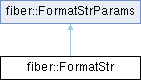
Formats a string and allows to pass an additional size parameter. More...
#include <OStream.hpp>
Public Member Functions | |
| constexpr | FormatStr ()=default |
| Default format constructor. | |
| constexpr | FormatStr (const char *str, size_t len) |
| Construcs a string formater. | |
| constexpr | FormatStr (const char *str) |
| Constructs a string from a terminated c-style string. I urge you to use FormatStr(const char* str, size_t len) instead. | |
| constexpr | FormatStr (const char *first, const char *last) |
| Constructs a string from a range given by the closed-open iterators [first, last) | |
| template<CStringView StringView> | |
| constexpr | FormatStr (const StringView &str) |
| constexpr FormatStr & | operator() (const char *str) |
| Assigns a string to the object. Allows to re-use formats. | |
| constexpr FormatStr & | operator() (const char *str, size_t len) |
| Assigns a string to the object. Allows to re-use formats. | |
| constexpr FormatStr & | operator() (const char *first, const char *last) |
| Assigns a string to the object. Allows to re-use formats. | |
| template<CStringView StringView> | |
| constexpr FormatStr & | operator() (const StringView &str) |
| Assigns a string to the object. Allows to re-use formats. | |
| constexpr FormatStr & | mwidth (int mw) |
| Sets the minimum number of character that will be put into the stream. | |
| constexpr FormatStr & | left () |
| Formats the string to the left area set by mwidth(). | |
| constexpr FormatStr & | right () |
| Formats the string to the left area set by mwidth(). | |
| constexpr FormatStr & | center () |
| Formats the string to the left area set by mwidth(). | |
| constexpr FormatStr & | fill (char c) |
| Sets the fill characters used by padding that is applied when mwidth() is used. | |
Static Public Member Functions | |
| static constexpr FormatStr | like (const char *str, size_t len, const FormatStrParams ¶ms) |
| static constexpr FormatStr | like (const char *str, const FormatStrParams ¶ms) |
| static constexpr FormatStr | like (const char *first, const char *last, const FormatStrParams ¶ms) |
| template<CStringView StringView> | |
| static constexpr FormatStr | like (const StringView &str, const FormatStrParams ¶ms) |
Public Attributes | |
| const char * | _str = "" |
| size_t | _len = 0 |
 Public Attributes inherited from fiber::FormatStrParams Public Attributes inherited from fiber::FormatStrParams | |
| AlignmentLRC | _alignment = AlignmentLRC::Right |
| int | _mwidth = 0 |
| char | _fill = ' ' |
Detailed Description
Formats a string and allows to pass an additional size parameter.
Constructor & Destructor Documentation
◆ FormatStr() [1/5]
|
constexprdefault |
Default format constructor.
◆ FormatStr() [2/5]
|
inlineconstexpr |
Construcs a string formater.
- Parameters
-
str Pointer to the start of the string len The length of the string, aka. the number of character that should be printed
◆ FormatStr() [3/5]
|
inlineconstexpr |
Constructs a string from a terminated c-style string. I urge you to use FormatStr(const char* str, size_t len) instead.
◆ FormatStr() [4/5]
|
inlineconstexpr |
Constructs a string from a range given by the closed-open iterators [first, last)
- Parameters
-
first The start of the string that should be printed. Points to the first character. last The end of the string that should be printed. Points past the last character.
◆ FormatStr() [5/5]
|
inlineconstexpr |
Member Function Documentation
◆ center()
|
inlineconstexpr |
Formats the string to the left area set by mwidth().
Example:
- Returns
- self
◆ fill()
|
inlineconstexpr |
Sets the fill characters used by padding that is applied when mwidth() is used.
- Parameters
-
c The new fill character
- Returns
- self
◆ left()
|
inlineconstexpr |
◆ like() [1/4]
|
inlinestaticconstexpr |
◆ like() [2/4]
|
inlinestaticconstexpr |
◆ like() [3/4]
|
inlinestaticconstexpr |
◆ like() [4/4]
|
inlinestaticconstexpr |
◆ mwidth()
|
inlineconstexpr |
Sets the minimum number of character that will be put into the stream.
Padded characters are defined by FormatStr::fill(char c). The default fill character is a space ' '.
Example:
- Parameters
-
mw An integer that sets the new minimal width
- Returns
- self
◆ operator()() [1/4]
|
inlineconstexpr |
Assigns a string to the object. Allows to re-use formats.
Like: FormatStr& operator()(const char* str)
- Parameters
-
first The start of the string that should be printed. Points to the first character. last The end of the string that should be printed. Points past the last character.
- Returns
- self
◆ operator()() [2/4]
|
inlineconstexpr |
Assigns a string to the object. Allows to re-use formats.
This function allows to create custom formaters and reuse them when printing - reusing code bloat and clutter.
Example:
Output:
- Parameters
-
str A terminated c-style string
- Returns
- self
◆ operator()() [3/4]
|
inlineconstexpr |
Assigns a string to the object. Allows to re-use formats.
Like: FormatStr& operator()(const char* str)
- Parameters
-
str A terminated c-style string len the length of the string
- Returns
- self
◆ operator()() [4/4]
|
inlineconstexpr |
Assigns a string to the object. Allows to re-use formats.
Like: FormatStr& operator()(const char* str)
- Parameters
-
str a string view like object. Has to offer the following two methods: - data(): that returns a pointer to the start of the stream
- size(): that returns the size/length of the stream
- Returns
- self
◆ right()
|
inlineconstexpr |
Member Data Documentation
◆ _len
| size_t fiber::FormatStr::_len = 0 |
◆ _str
| const char* fiber::FormatStr::_str = "" |
The documentation for this struct was generated from the following file:
- fiber/OStream/OStream.hpp